
تقدیم به نسلهای بعد از سال 1357
ترانه دریانورد کهنسال
تقدیم به نسلهای بعد
از سال 1357
ترانه دریانورد کهنسال
اثر ساموئل تیلور کولریج
پی نوشت: ترجمه ی فارسی این اثر در ایران منتشر شده است (لطفاً اینجا را کلیک کنید).
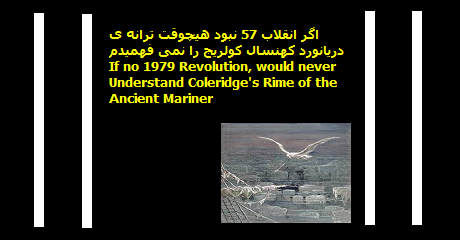
ساموئل تیلور کولریج، شاعر و منتقد انگلیسی که بین سال های 1772 و 1834 زندگی می
کرد و جنایاتی را که انقلاب فرانسه علیه آنهائی که خود انقلاب کرده بودند به چشم
خود دیده بود، منظومه زیبائی تحت عنوان
«ترانه دریانورد کهنسال» در قالب داستان
کشتن پرنده دریائی خارق العاده ای به رشته تحریر درآورده است. این اشعار بیان
احساسات نسلی بود که آن مصیبت ها را با گوشت و پوست خود تجربه کردند، و گوئی همه
دردها از زبان یکی از انقلابیون بیان می شود که در قامت ملوانی پیر در کنار خیابان
تحول اجتماعی ایستاده و به هر کس که در آن راه پای می گذارد داستان کشته شدن
«مرغ
دریائی آزادی» را بازگو میکند. بسیاری از دوستان کولریج پس از تجربه انقلاب فرانسه
به محافظه کاران ضدانقلابی تبدیل شدند اما برخی نیز لیبرال باقی ماندند. منظومه
کولریج بیان افسوس ها و طلب بخشش از سوی آنهایی است که از زیاده روی های انقلاب
بجان آمده و با بیانی زیبا و شاعرانه فغان آنهاست که به نسل های بعد منتقل می شود.
--------------------------------------------------------------------------------------------------
Dedicated to the Post-1979
Iranian Generations
Rime of the Ancient Mariner
By Samuel Taylor Coleridge
Newsgroups: soc.culture.iranian
From: Sam Ghandchi
Subject: Rime of the Ancient Mariner
Date: Tue, 3 Nov 1998 05:25:21 GMT
The following are from "THE RIME OF THE ANCIENT MARINER" of Samuel Taylor
Coleridge (1772-1834), the English poet and critic. Coleridge was from a
generation who had seen the atrocities that the French Revolution had committed
against its own children. This may be interesting as one looks at the Iranian
Revolution.
Many of Coleridge's friends became fascist anti-revolutionaries after that
experience. But some became liberal. Coleridge's Rime of the Ancient Mariner
expresses the regrets, apology, and the desire for forgiveness by the ones who
were tired of the excesses of that Revolution, in a beautiful poetic expression:
The old sea-faring man gets to tell his story to a guest
who is going to a Wedding. The Mariner says how his
ship sailed in good wind and fair until it was drawn by a
storm to the South Pole. The land of ice, and fearful
sounds, where no living thing was to be seen.
Till a great seabird, called Albatross, came through the
snow-fog, and was received with great joy and
hospitality, And lo! the Albatross proveth a bird of good
omen, and followeth the ship as it returned northward
through fog and floating ice.
"At length did cross an Albatross,
Thorough the fog it came;
As if it had been a Christian soul,
We hailed it in God's name.
"It ate the food it ne'er had eat,
And round and round it flew.
The ice did split with a thunder-fit;
The helmsman steered us through!
"And a good south wind sprung up behind;
The Albatross did follow,
And every day, for food or play,
Came to the mariners' hollo!
"In mist or cloud, on mast or shroud,
It perched for vespers nine;
Whiles all the night, through fog-smoke white,
Glimmered the white Moon-shine.
"God save thee, ancient Mariner!
From the fiends, that plague thee thus!-
Why look'st thou so?" - With my cross-bow
I shot the Albatross"
The ancient Mariner inhospitably killeth the pious bird of
good omen. His shipmates cry out against the ancient
Mariner for killing the bird of good luck. But when the
fog cleared off, they justify the same, and thus make
themselves accomplices in the crime. But a plague befalls
on them and shipmates drop down dead one after
another. Miraculously, The Ancient Mariner is saved in
the Pilot's boat. But the penitence of life befalls on him.
"Since then, at an uncertain hour,
That agony returns:
And till my ghastly tale is told,
This heart within me burns.
"I pass like night, from land to land;
I have strange power of speech;
That moment that his face I see,
I know the man that must hear me:
To him my tale I teach.
"Farewell, farewell! but this I tell
To thee, thou Wedding-Guest!
He prayeth well, who loveth well
Both man and bird and beast.
"He prayeth best, who loveth best
All things both great and small;
For the dear God who loveth us,
He made and loveth all.
"The Mariner, whose eye is bright,
Whose beard with age is hoar,
Is gone: and now the Wedding-Guest
Turned from the Bridegroom's door.
"He went like one that hath been stunned,
And is of sense forlorn:
A sadder and wiser man,
He rose the morrow morn."
The use of masculine pronouns for undefined third
person singular is in the old 1834 edition.