
http://www.ghandchi.com/iranscope/Anthology/KavehFarrokh/index.htm
The Alexander Movie: How are Iranians and Greeks portrayed?
By Dr. Kaveh Farrokh
manuvera@aol.com
Tuesday, Nov 30, 2004 2:07 PM
Hollywood
has just released one of the latest of its epic blockbusters: Alexander the
Great. Directed by distinguished director Oliver Stone, the movie endeavours to
recreate the events of the Hellenic conquests and the downfall of the first
Persian Achaemenid Empire. It is important to note however, that simply because
a movie is high budget, casts high profile Hollywood actors and is directed by
top ranking directors, does not make it flawless.
Beyond the entertainment value of Oliver Stone's latest project, a number of
serious errors do exist in the movie, many which may appear trivial. These
"trivial" errors will nevertheless be of consequence to both Iranians and
Greeks.
Ironically, it has been my Greek friends and colleagues who bought the flaws of
Oliver Stone's "Alexander" picture to my attention. There are a total of five
overall errors that will be listed and discussed below:
(1) The Battle of Gaugamela:
Oliver Stone has relied on Professor Robin Lane Fox, one of the world's foremost
experts in the area of Alexander and Hellenic Studies. His book is a standard
reference text in the area of Alexandrian Studies:
R.L. Fox. Alexander the Great. London: Penguin, 1986 and 1994.
ISBN: 0140088784
Despite excellent reviews of his book by critics and scholars, Dr. Fox does not
understand the military of ancient Persia. A typographical shot of the battle of
Gaugamela, shows the Greeks advancing in ordered and disciplined ranks. In
contrast, the armies of Darius III are shown as little better than an amorphous
mob. This is a false image of the Achaemenid army. The Achaemenids used drums
and musical instruments to direct the marching tactics of their troops in
battle. Second, the Achaemeneans used the decimal system, which was in fact,
unknown to the Greeks of the period. Persian units were formed in legions of 10,
100 or 1000 or 10,000. A typical term was "Hezar-Patesh" (roughly equivalent to
"leader of a thousand men").
In addition, the Persians had developed a sophisticated system of heraldry and
their troops wore standard uniforms. The Greeks were certainly excellent
fighters and were thoroughly organized, but this does not mean that the Persians
were not. At the time, the Greeks were militarily superior with respect to
armaments, tactics and military training.
This military imbalance changed with the coming of the Parthian and Sassanian
cavalry. The Iranian Savaran (elite Cavalry) successfully halted and defeated
many of the later Greek-Hoplite inspired Roman armies. Many Romans attempted to
imitate Alexander and failed against Persia. These include Marcus Lucinius
Crassus at Carrhae, Marc Antony at Tabriz (where he failed twice), Gordian III
at Mesiche, Phillip the Arab near modern Syria, Valerian at Barbablissos, and
Julian the Apostate in Mesopotamia. I personally doubt that Hollywood will
recreate these spectacular Roman defeats as these will challenge contemporary
western notions of the Alexandrian legacy. In addition, many Iranians today are
unaware of the proud legacy of the Parthian and Sassanian Savaran.
Professor Fox's elementary grasp of Iranian militaria should not inspire much
confidence with respect to accurate portrayals of Iranians in general. You may
wish to read the following books by Professors Sekunda and Head who are experts
on the uniforms, dress and equipment of the ancient Greeks and Achaemenid
Persians.
N. Sekunda. The Persian Army: 560-330 BC. England. Osprey Men at Arms Elite
Series, 1992.
ISBN: 1855322501
http://www.ospreypublishing.com/title_detail.php/title=P2501
D. Head. The Achaemenid Persian Army. England: Montvert Publications, 1992.
ISBN: 1874101000
There are many errors with the uniforms portrayed as "Persian". As you will see
in these books, the colors and materials of Achaemenid Persians were invariably
bright with a mix of shades of purple, Saffron, red dyes, shades of blue and
green, mixed with darker browns (almost Burgundy) and black. These fashions and
regalia were resuscitated during the Sassanian dynasty (226-651 AD). Only the
Persian archers (and a few guards) are shown with some accuracy; the same cannot
be said with respect to the other "Persians" of the movie set.
More puzzling is the "Arabesque" way in which ancient Persians are portrayed in
this battle. I was shocked to see Arabian camel riders used to portray one of
the vanguards of Darius III's attack on Alexander at the battle scene. Arabs
were simply auxiliary units in the Achaemenean army at the time, and were not a
major factor. Camel troops were never a major battle order in the armies of
Persia. I also noticed that an infantry troop of the Achaemenid advance guard
was speaking in Arabic. Persian is not related to Arabic; it is an Indo-European
language akin to the languages of Europe and India.
This may be the usual Hollywood habit however of portraying Iranians as Arabs, a
topic we will re-visit later in this commentary.
(2) Confusing Persia with Babylon
It is very interesting that Professor Fox does not refer to the Achaemenid
capitals in Susa, Maracanda (Samarqand), Media or Persopolis. The destruction of
Persopolis by Alexander is a major event - instead the movie shows Alexander
entering the city of Babylon, implying that this was the administrative capital
of Persia. Babylon was simply another satrapy of the empire; not its capital.
Babylon had already been incorporated into the Persian Empire in 539 BC by Cyrus
the Great (559-530 BC). Why is Persopolis and its destruction not mentioned?
There was also the destruction of the three major Zoroastrian texts by Alexander
- also not referred to in the movie.
A possible reason for this may be found in Professor Fox's.interview with the
distinguished journal "Archeology Today" (Riding with Alexander) (enter link
below into your internet browser):
http://www.archaeology.org/online/interviews/fox.html
Note the statement below, and how indicative it is of Professor Fox's lack of
understanding of Classical Achaemenid Persia:
"We all understood that the separate "parts" of Oliver's drama must be
"color-coded" and … which could not totally depart from audiences' expectations
of Greek or Babylonian imagery"
Note the statement "Greek or Babylonian imagery". This statement implies that
Persia had no real arts worth mentioning, and that Persia is simply an extension
of Babylon or at best interchangeable.
As noted previously, Babylon was not a major power at the time of Alexander.
Persian arts and architecture were an eclectic synthesis of indigenous (e.g
Median, Elamite), Lydian, and Mesopotamian styles, including Babylonian. The
city-palace of Persopolis is very distinct and cannot be crudely termed as
Babylonian. It is, to put it mildly, shocking, that the treatment of Persian
studies is addressed at such a shallow level by Professor Fox.
An important point must be made, especially with respect to the reason why
Alexander was so violent in his conquest of Persia. The Greeks were simply
taking revenge for the earlier invasion of their country by Darius the Great and
his son Xerxes. The Greeks paid a heavy price for their battles at Marathon (490
BC), Thermopylae (17th September, 490 BC), Athens (27th September, 490 BC),
Salamis (29th September, 490 BC), and Plataea (479 BC). It is significant that
when Xerxes burned Athens, he ordered the sacred statues of the Greek gods to be
removed and brought to Persia. The Greeks revered their gods and this Persian
act was a national insult to them. Most contemporary Iranians are not aware of
these facts. This certainly is not an excuse for what happened at Alexander's
time, but it does help put these events in perspective.
Although many Iranians demonize Alexander, the man did come to develop a great
deal of respect for Persia. The more Alexander stayed in Persia, the more
"Persian" he became, in manners and in dress. Alexander paid his respects at the
tomb of Cyrus the Great and indeed saw himself as the heir of Cyrus. The Greeks
so admired Cyrus the Great, that they saw his manner of government as a model.
You may wish to read the Greek "Cyropedia". If Aristotle made racist statements
about the Persians (and this is shown in the movie), it must also be made clear
that many Greeks also praised the Persians (see Xenophon or Plutarch in his
discussion of the Parthian general Surena). A very positive aspect of the
Alexander movie is that Alexander praises the "east" for its architecture and
civilization. It is possible that Alexander was poisoned by some of his officers
for becoming too "Persian".
(3) The Blondism of Alexander
A very serious concern of the Alexander movie is the promotion of the idea of
the "Nordicism" of ancient Greece. Put simply, this is the thesis that ancient
Greeks were not only predominantly blonde, but "Nordic", in the manner of
present-day Scandinavians and Northern Germans.
Nordicists have long argued, since the late 1700s, that the people of ancient
and modern Greece are unrelated. Nordicism argues that the "ancient" Greeks were
the "true" Greeks in contrast to the non-Nordic people of Greece today. This
view is exemplified by the Austrian Hellenicist, Professor Fallmerayer, in the
1830s, who noted that "not a drop of pure Greek blood runs in the veins of
modern Greeks…" To this day, Fallmerayer is recalled with bitterness and
derision in Greece. It is worth noting that Fallmerayer never set foot in Greece
in his entire lifetime. For further discussion on these issues you may wish to
read:
Felipe Fernandez-Armesto's "Guide to Peoples of Europe", especially pages
207-216.
Published in London by Times Books in 1994.
ISBN: 0-7320-0624-5
Fallmerayer's analysis of Greece is not entirely correct. While true that the
Ottoman Turks ruled Greece for 400 years and that previous Byzantine rulers
(e.g. Emperor Nikopherous) had to import colonists from present day south Italy
to help repopulate parts of Greece ravaged by wars, many of these "Italian"
colonists were themselves ancient Greek, settled in regions such as Calabria and
Southern France since the times of Darius the Great and earlier. In any event,
there has always been a strong and predominant Greek element in areas such as
the Peloponnesos.
As for the lack of mainstream Nordiscism in modern Greece, this has to do with
the history of ancient Greece itself. Mainland Greece was already settled with
indigenous Mediterranean peoples, such as the ancient Minoans, before the
arrival of the Classical Greeks. Ancient Greece, like today, was a mixture of
Mediterranean and "blonde" peoples.
This leads to a very crucial question: why have no Greek actors been selected to
portray classical Greeks such as Alexander, Hephaestion, Ptolemy I, Olympias,
King Phillip II, Cassander or Antiginous? For a review of the cast, click on the
following links (enter links below into your internet browser):
http://www.alexander-the-great.co.uk/
http://www.lilianagimenez.com/artisti-ospiti/raz.jpg - Israeli actor, Raz Degan
who portrays Darius III.
If one were to use Classical Greek works of art (vases and statues specifically)
as a standard for prototypical Greek physical appearance, one can then easily
find a plethora of modern Greek actors and actresses today who can portray
ancient Greeks. It is interesting as to why Oliver Stone did not select
Hollywood actors of Greek descent or from mainland Greece.
Oliver Stone goes further however. Colin Farrell, a dark haired Irish actor, who
plays Alexander, is portrayed literally, as a bleached blonde. The notion of
Alexander being Flaxen-haired or blonde is itself a matter of considerable doubt
if not strong dispute. As noted by my friend George Tsonis, a Greek-Canadian and
a scholar of Greek, Roman and Persian history, the Greek word for Alexander's
complexion is "Xanthenein" (fair). This description simply marks Alexander's
complexion as being fairer than the other Greeks of his time. Yes, he was
relatively fair, but not necessarily flaxen-blonde in the Nordicist sense. From
the Tufts University Lexicon "Xanthenein" is roughly translated as fair or a
yellowish-brown color. A related term, "Xanthizo", can also be to "make yellow"
or "brown". No wonder there is confusion!
Plutarch, whom most western scholars rely on for their references, does not
actually describe Alexander's hair color, only his complexion. This is a quote
from Aelian on the hair; below is the Anglisized Greek from Cyrillic and the
English translation below that:
"Alexandron de ton Filippou apragmonos oraion legousi genesthai' tin men gar
komin anasesyrthai afto, xanthin de einai'"
"Alexander the son of Philip is reported to have possessed a natural beauty: his
hair was wavy and fair"
Varia Historae, 12.14
To see the debates raging about Alexander's true appearance see the following
discussion panel (enter link below into your internet browser):
http://www.pothos.org/forum/showmessage.asp?messageID=16281
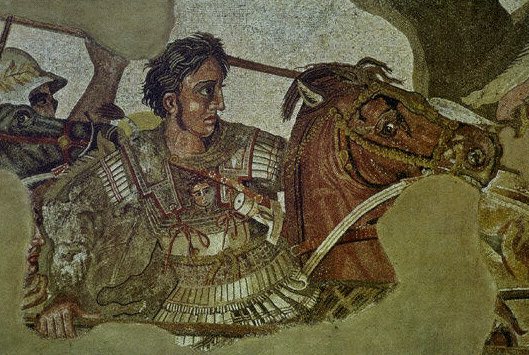
A very non-Nordic portrayal of Alexander is evident in the Pompei Mosaic. It is
agreed by a majority of scholars that the painting is a faithful rendition of an
original Hellenistic painting of the 3rd century BC. As you will witness in the
painting below, this Hellenic-Roman version of Alexander is very different from
the contemporary Hollywood fantasy interpretation (see photo below):
As you see in the photo, this is a very different Alexander than what many
western scholars and Hollywood would have us believe.
This painting appears to refutes the notion of Alexander being blonde.
Nevertheless, a number of western scholars remain determined to push forward an
image of Alexander that may be false. There are scholars who are actually
convinced that the Pompei mosaic is proof of Alexander's Nordic blondeness! Even
in allowing for poor reproductions, the mosaic clearly shows a 'brown' haired
person with a Mediterranean or modern Iranian profile. Many Greek and Iranian
people today have auburn-brown hair, which can appear to be somewhat "blonde" in
sunlight.
The point from the Greek perspective however, is not simply whether Alexander
was blonde or not. After all, the Dorian Greeks were blonde as a rule, just as
the original Persians and Mede settlers of ancient Iran were as well. The issue
is that of using the notion of blondeness to project a specifically non-Greek
Nordic west European image. Irrespective of whether Alexander was blonde or not,
he represented the culture of ancient Greece, which is not necessarily the same
as that of modern Western Europe.
Ancient Greece and Rome, as we will note again further below, were Mediterranean
empires, very different from the inhabitants of interior and northern Europe.
The peoples of western and eastern Europe were very different from the Classical
Greeks in culture, language and temperament. To obtain an introduction to the
history of the northern Europeans, you may wish to read:
D. Rankin. Celts and the Classical World. London: Routledge, 1996.
ISBN: 0-415-15090-6
A. Ferrill. The Fall of the Roman Empire: The Military Explanation. Thames &
Hudson, 1986.
ISBN: 0500274959
The "Europeans" adopted a great deal of their civilization and identity from the
Greeks and the Romans. Even the name "Europe" is derived from the ancient Greek
term "Oropia". It may not be an exaggeration to state the following: with their
adoption of Greco-Roman culture, west European scholars in particular, have
essentially affected a "Nordic makeover" of the ancient Greeks and Romans. As
Western culture has adopted the mantle of ancient Greece, it has also adopted
Alexander as its own son; to the point that Alexander and ancient Greece are
viewed as identical with ancient Western Europe and Scandinavia.
The Nordicising of favourite historical figures does not end with Alexander.
Jesus Christ, is frequently portrayed as a slightly built, tall blonde Nordic
man. Jesus or Jeshua, was a Jew from West Asia who spoke Aramaic. It is now
acknowledged by a number of researchers that much of what we accept as the
"appearance" of Jesus is not altogether accurate. Jesus would most likely have
resembled a modern Fertile Crescent Arab or Jew from places such as Jerusalem,
Amman, Hebron, Damascus or Basra. Scientists have recently reconstructed the
image of Christ as he would have most likely appeared in his lifetime in ancient
Palestine and Judea (see photo below):
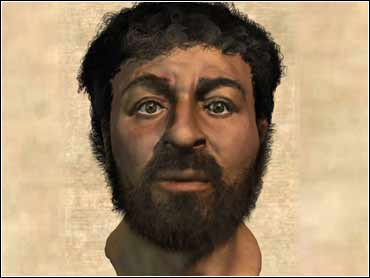
The reconstruction that you witnessed in the attachment is very different from
the icons we are used to seeing in the churches and Christian arts of
Northwestern Europe. How many images have you seen in North American or Western
European churches that show the Aramaic Christ? It would seen that, like
Alexander, the "real image" of Jesus has shifted in accordance with politics,
ideology, dogma and popular culture over the centuries. Interestingly, many
cultures across the world today interpret Jesus' physical appearance in
accordance with their own anthropomorphic image (enter link below into your
internet browser):
http://dsc.discovery.com/convergence/jesus/photo/photo.html
It appears that Hollywood has successfully associated a certain physical
appearance with modernity, progress, success and rationalism. By implication,
that which is not of that "certain look" is in danger of being associated with
all that is the antithesis of that. With this logic, historical reality is bent
to fit a manufactured reality: a fantasy.
(4) Greek or Macedonian?
This movie contains a number of concerns to Greeks in particular, such as
Macedonia being "different" from the rest of Greece, a very contested issue in
the Balkans these days. Although not generally reported, the government of
Greece, which had originally supported the Alexander picture, withdrew its
funding and support for Oliver Stone's project (enter link below into your
internet browser):
http://www.hri.org/news/greek/ana/1998/98-11-17.ana.html#19
There was to have been co-operation between Stone and the Greek government, but
this was apparently changed when the details of the script became known (see
also (4) below).
To be honest, I was left confused as to whether the Macedonians were Greek or
not. This may be an attempt to placate those who view Macedonia as "different"
from Greece, not unlike those who try to argue that Kurds and Azerbaijanis are
not Iranians. The Greeks, like the Iranians today, are now confronted with
having to defend their historical heritage against those who have territorial
claims against their nation. The Oliver Stone picture, in my opinion, does not
clearly define Macedonians as Greeks.
In addition to these concerns, many Greeks are offended by the bisexual
portrayal of Alexander. It is also rumoured that many Greek associations may
have plans to sue Oliver Stone.
Again, ancient Greek terminology and its translations by western scholars may
have played a role in the "bisexual" interpretation of Alexander. We have
already seen how the term "Xanthenein" has been stretched to paint a
"Scandinavian" Alexander.
(5) The Portrayal of Roxanna and the Perpetuation of the "Hollywood Persian"
My wife Parnian and I, as Iranians, found the portrayal of Roxanna insulting.
This portrayal has been defined by the aforementioned Professor Fox, whose has
already been noted for his shallow understanding of Persian arts and
architecture. Professor Fox's portrayal of Roxanna also indicates that he has
very little knowledge of Iran's anthropological history.
The portrayal of ancient Iranians is outright comical, if not insulting. The
inaccurate Hollywood portrayal of Iranians is exemplified by the selection of
Rosario Dawson ( http://www.lostfocus.de/archives/rosario_dawson.jpg ), a very
talented, beautiful and intelligent black actress, to star as Roxanna, an
ancient Iranian queen from Soghdia-Bactria. Roxanna was not black, anymore than
Alexander was Scandinavian. Having Rosario Dawson portrayed as Roxanna makes as
much sense as having Lucy Liu, an Asian-American, portraying Queen Victoria of
Great Britain.
The term Roxanna is derived from Old Iranian "Rokh-shwan" or "face (Ruksh) -
fair skinned-shiny (shwan)". Roxanna was related to a North Iranian tribe known
later as the Sarmatians, the remnants who survive in the Caucasus and Russia as
the Ossetians (ancient Alans or Ard-Alans)
Roman sources such as Pliny repeatedly describe ancient North Iranian peoples
such as the Alans and Seres as "…flaxen (blonde) haired blue eyed nomads…" (see
Wilcox, p.19). Rosario Dawson does not fit the description of an ancient Iranian
woman, especially from Northern Iranian stock. The Ossetians of today,
descendants of ancient Northern Iranians, predominantly resemble northern
Iranians and Europeans and speak an archaic Iranian language (like the Avesta of
the Zoroastrians). Blondism is very common among these descendants of ancient
North Iranians in cities such as Beslan and Vladikafkaz. It can be argued that
Roxanna was a brunette, however, she was of Northern Iranian stock, which would
still make her very different from actress Rosario Dawson.
There are plenty of talented actresses of Iranian descent in North America alone
that would well fit the historical Roxanna. Oliver Stone could have just as
easily selected an Iranian actress, however he relied on the historical
"expertise" of Professor Fox. The question that can be addressed to Professor
Fox is this: what makes Rosario Dawson so representative of Iranian women and
Roxanna in particular? Is the Professor aware of the anthropology and history of
ancient Iran as it was at 333 BC?
More puzzling is the design of Roxanna's costume in the movie. Note the photo
showing the marriage of Alexander to Roxanna. Roxanna appears to wear a Burka-like
veil constructed of strips of metallic mesh in which the face is partly hidden.
See the photo (enter link below into your internet browser):
http://www.alexander-the-great.co.uk/showimages.php?id=alex3_l.jpg
The headgear is partly correct if we base the costume on the Saka Paradraya
Iranian speaking tribes of the present-day Ukraine (8-4th centuries BC). The
decorations on the headgear are simply wrong and Iranian queens did not wear
face masks of any type. For a discussion of the Saka Paradrya, known in the west
as Scythians, consult:
E.V. Cernenko. The Scythians 700-300 BC. London: OspreyPublishing, 1989.
ISBN: 0850454786
See colour plate G.
Once you have consulted Professor's Cernenko's book, it will be evident how
flawed the costume design is, not to mention the colors. None of the
reconstructions by Professor Gorelik, which Cernenko has consulted, show any
type of face masks for ancient Iranian women. Ancient Iranian women, who were
found in military, religious and political leadership roles, simply did not wear
such attire during courtship, marriage or everyday duties.
It is not clear why Professor Fox has chosen a Burka-like face mask for Roxanna
at Alexander's wedding. Variants of this face mask are present in Afghanistan
today, mainly the result of former Taliban rule and very conservative Pashtoon
tribal society, which very strongly identifies itself with the culture of
ancient Arabia.
Even more interesting is the "Arabian Nights" portrayal of an Achaemenid harem.
Harems certainly existed in Persia and the later Roman and Byzantine courts,
however the specifically "Arabian" appearance accdored to the Achaemenids is
simply consistent with the Hollywood tradition of portraying Iranians as Arabs.
Interestingly, the movie portrays the "Persians" with Arabian styles of music
and dance. This portrayal is not based on factual information; it is a Hollywood
portrayal. From the scant evidence that exists, we do know that one of the
Persian styles of dance strongly resembled the dances of the Kurds of today; a
style also seen in western Turkey, Greece and the Balkans today. As for music,
we have no notes or scales from that period, and "Arab music" as we know it
today simply did not exist at that time; it is a much later creation. Arabian
music can trace its beginnings to the Bedouin tribes of Arabia - it later
borrowing heavily of Sassanian and Greek scales (after the 7th century AD).
These errors are enough to question the historical accuracy of the Alexander
picture. It seems that when it comes to Iranians and their identity, history is
easily "re-written" for the benefit of popular entertainment. As Professor Fox
has duly noted in an interview with Archeology Today (http://www.archaeology.org/online/interviews/fox.html),
the movie "could not totally depart from audiences' expectations". The
"audience" undoubtedly has "expectations" as to what Iranians "should" look
like.
Given Professor Fox's rudimentary knowledge of Persia's anthropology, you may
wish to refer to:
J.P. Mallory. In Search of the Indo-Europeans: Language, Archeology and Myth.
London: Thames & Hudson, 1989.
ISBN: 0-500-27616-1
Read pages: 9-23, 48-56, 78, 266-272.
An excellent article by Dr. Oric Basirov is posted as well:
http://home.btconnect.com/CAIS/Religions/iranian/Zarathushtrian/Oric.Basirov/origin_of_the_iranians.htm
For color reconstructions of ancient Iranians see:
P. Wilcox. Rome's Enemies (3): Parthians and Sassanid Persians. London:
OspreyPublishing, 1986.
ISBN: 0850456886
T. Newark. The Barbarians. London: Concord Publications Company, 1998.
ISBN: 9623616341
See Page 7 (the Saka - ancestors of today's Lurs and Seistanis) and 30
(ancestors of the Ard-Alan).
Iran today is very much a genetic tapestry that includes blondism in Northern
and Western Iran (e.g. Parsabad, or Talysh), as well as among Iranian peoples
such as Lurs, Azeris, Mazandaranis, Kurds and Boyer-Ahmadis. Iran is also home
to Arabians in Khuzistan and the Persian Gulf coast, Asiatic Turcomens in the
Northeast, as well as the Baluchis near Pakistan, who have a strong Dravidian
admixture. You may wish to read the very thorough and precise compendium of
Iranian peoples today by:
F. Hole (Editor). The Archaeology of Western Iran: Settlement and Society from
Prehistory to the Islamic Conquest (Smithsonian Series in Archaeological
Inquiry). Washington, D.C.: Smithsonian Institution Press, 1987.
ISBN: 0874745268
W. B. Fisher (Editor). The Cambridge History of Iran: Volume 1, The Land of
Iran. Cambridge: Cambridge University Press, 2004.
ISBN: 0521069351
These books (especially the Cambridge History of Iran series) will provide a
more informed and less misleading analysis of Iran's anthropological history
than that offered by Professor Fox.
As seen in this commentary, Hollywood portrayals of Iranians are in stark
contrast to reality. Until the Arabian arrivals in the 7th century AD, the
majority of Iranians would have looked no different from the Greeks or Romans.
Greek and Roman references to classical Iranians do not refer to them as
different in the "physical" sense; differences lay mainly in manner of
government, philosophy and to a lesser extent, mythology. The Azadan nobility of
the Parthian and Sassanian Savaran (elite cavalry), more than 500 years later
than Alexander, are described by Peter Wilcox as "…very similar to the
Celts…strikingly similar to Northwest Europeans…" (p.6). There are still many
short stories in Southern Italy today which accurately portray the temperament
and appearance of the Persians as they would have appeared in antiquity.
= = = = = = = = = = = = = = = = = = = = = = = = = = = = = = = = = = = = = = = =
= = = =
Despite the powerful historical revisionism of a number of mainly northwest
European historians such as Edward Gibbon (1737-1794) or the aforementioned
Fallmerayer, the Greco-Roman world and Persia have profoundly influenced each
other in areas such as architecture, the arts and crafts, the sciences and
medicine, mythology, military and engineering technologies. While true that one
can find a number of anti-Persian references in Greco-Roman sources, these were
in the context of wars that broke out between these powers. A perfect example of
this is how the movie explicitly shows Aristotle deriding the Persians as
inferior to the Greeks. Modern Greeks place this in context and see Aristotle as
expressing the political climate of his day. Iranians are very well liked and
respected in Greece and are seen as the heirs of a great civilization. Alexander
himself came to greatly appreciate the Iranians and their culture. It is a shame
that the movie did not show Alexander as paying homage to the tomb of Cyrus the
Great.
As noted previously, Greco-Roman historians who were prepared to acknowledge and
highly praise the Persians (e.g. Xenophon, Plutarch, etc.). Today's popular
culture, education systems and movie entertainment industries in particular,
seem to be providing a very selective and distorted view of Persia with respect
to antiquity. Many are simply not aware (or wish not be aware) of Persia's
importance and status in antiquity let alone her major contributions to world
civilization.
Ancient Greeks, Romans and Persians had much more in common with each other than
with the relatively unsophisticated Celtic and Germanic peoples who were roaming
the Northern European forests. For an incisive discussion of these little
discussed topics consult:
N. Spatari. Calabria, L'enigma Delle Arti Asittite: Nella Calabria
Ultramediterranea. Italy: MUSABA, 2003.
ISBN: 8887935300
As far as I know, this book has still not be translated from Italian to English.
Still an excellent read, especially with the illustrations.
P. Kriwaczek. In Search of Zarathustra: The First prophet and the Ideas that
Changed the World. Weidenfeld & Nicolson, 2002.
ISBN: 0297646222
I look forward to the day when we will see blockbuster movies of Shapur I
(241-272) who defeated three Roman emperors in his lifetime and destroyed a
third of Rome's armies. Even more dramatic would be to see movies made of the
life and times of figures such as Zarathustra, Aryaman, Shahrbaraz, Mani, Mazdak,
Babak, Abu Ali Sina or Omar Khayyam.
Dr. Kaveh Farrokh
Manuvera@aol.com

