A Theory of
Uniqueness Value
A Theory of
Uniqueness ValueSam Ghandchi
http://www.ghandchi.com/2336-uniqueness-english.htm
A Theory of
Uniqueness Value
Sam Ghandchi
http://www.ghandchi.com/2336-uniqueness-english.htm
http://iranpoliticsclub.net/features/theory-uniqueness/index.htm
یک تئوری ارزش ویژه
http://www.ghandchi.com/2336-uniqueness.htm
P.S. Oct 22, 2023: Two weeks ago I mentioned this paper in an interview at Mehestan. I wrote this paper 4 years after my 'Intelligent Tools' paper which was published in AI Journal in Fall of 1985. In 1989, I tried to publish this paper in a few Economics journals and was not successful and contacted the late Daniel Bell who tried in a letter to make suggestions to me as to what to add to this paper to get it published! But I got busy doing other things and gave up on publishing this paper! I published a part of this paper in SCI Usenet Newsgroup at the time of first major crisis of post-industrial economy of Silicon Valley in 2001 under the title of 'Social Justice and the Computer Revolution,' and received a few comments, but never formally published this paper anywhere! In the last part of 20th Century till today, a few shallow economic ideas have surfaced on the scene one of them being the utterances of Ayn Rand, popular among the American Libertarians! Also in recent months I have seen a few papers by Nobel Laureate Joseph E. Stiglitz *, which are in a way, going back to ideas of European Social Democracy of mid 20th Century! Hopefully soon we will see more serious work on economics for the 21st Century! I hope more economists study economic contributions of Kurzweilian Futurism, which will be our guiding light as human civilization will be going through Technological Singularity *, something neglected for the most part by professional academics! SG
P.S. Nov 29, 2020: Supplement to Theory of Uniqueness Value after 31 Years: Pricing of Postindustrial Products
P.S. Feb 2, 2003: [OPE-L:8424] Re: Electronics, Education and Value *
Introduction, Nov 10, 2018: This paper was written 30 years ago in English in 1989 and it is about how the value of knowledge-centric products in a post-industrial economy is determined. The discussion is that value here, contrary to products of industrial economy is not determined by average, rather it is determined by best or what is perceived as best. The result of this view is a new issue of social justice in the post industrial economies which was discussed in 2003 after the 2001 crisis of Silicon Valley in California and in 2014 in a discussion with Mr. Piketty, it was said that Winner-Take-All is the Problem.
Related Papers: 1
Preface 2003
Recently I wrote an article entitled entitled "Social
Justice and the Computer Revolution" which raised many questions for the
readers. For example, some asked me that with the fundamental change of social
justice in the economic arena, which I had discussed, what solution is there for
social justice in the post-industrial economies. Others asked me about
what changes in the tax system would be necessary. I tried to answer the
questions. But the readers can best answer the questions for their own
particular area of interest of economics if they study the original economics
paper of mine which is below. My article about social justice was a part of this
paper which is presented below.
Daniel
Bell's Letter about Theory of Uniqueness Value, which he sent me on
September 5, 1989, Daniel Bell wrote an excellent feedback about this paper and
specifically about the topic of
value in the post-industrial societies, and suggested that I use the
Wassily Leontief
's input-output model to transform *uniqueness values*, that I had
proposed in this paper, to market values in the total world economy in a process
of Walrasian Tatonnement.
Unfortunately since then, I I have not had found the opportunity to spend more
time on the model that I have presented here. I hope to test this theory
using Leontief's input-output model to prove or disprove it.
In fact, the existence of organized futures commodity markets such as Chicago Board of Trade has created a good environment to test the theory. Of course Daniel Bell had correctly reminded me by homogenizing prices, including labor, the mathematics gets simple. and that without homogenizing prices, the number of nonlinear equations gets too many and the calculation of transformation of uniqueness value to market value with the state of the tools of mathematical economics of late 1980's was seemed to be an impossible task.
Daniel bell in the same letter gave an interesting example about the economic value of Einstein's theories and his example was very well related to the topic of this paper. Also he had written that he was working on a book which would be the extension of his knowledge theory of value which he had proposed in 1973, and it would be in response to critics of his colleagues about the relation of his work and tatonnement. but I have not seen him publishing the work and am not sure if he ever continued the project or not.
In the same place, Bell correctly mentioned that "Marx was quite aware of the problem and in the Grundrisse, he assumed it would disappear because scarcity would disappear and the question of valuing labor would disappear." Of course these words of Marx are correct, and I have even shown that years before Grundrisse, Marx had been aware of it. But as I have shown in this paper, with the reduction of the significance of labor time, the issue of creative activity not only will not disappear but in the post-industrial societies it will become the main issue of the reward of human activities.
It is interesting that
Willis Harman, also in 1989, in a
letter to me about this paper, emphasized that the labor theory of
value would no longer make sense in a high-technology age. And
continued that "if the whole value structure of society is shifting such that
more and more persons are going to be considering work as primarily life
fulfillment-rather than toil for wages so that one can seek fulfillment after
hours-then I'm not sure we will have quite the same interest in quantifying the
results of work. I am not sure what that says about the desirability of having a
two-dimensional theory of value". I should say that he was right in noting that
defining value in its industrial form, meaning labor time, loses its
significance with the growth of post-industrial society, and I have also
emphasized that in this paper, but my endeavor in defining the value of human
creative activity does not mean the value of work in its industrial form, and in
fact in the post-industrial societies, the importance of defining the value of
human creative activities, not only is not diminished, but as I will show it
will become more and more important.
Summary of Paper
In this article, I am proposing the division of exchange value into two kinds.
The first kind is related to the human activity as work. It is determined as in
the classical theory of value by the average labor-time. The other kind of value
which is proposed in the article I call *uniqueness value*, and is related to
human activity as a
free creative activity. It is my claim that this "uniqueness
value" is determined by the best and not the average human activity of the
similar nature. Needless to say that both of these "values" are "exchange"
categories and are not "use values." Moreover, I argue that the transformation
between these two kinds of value is the cause of the dilemma of social justice
in the dawning new civilizations. I show that the increasing importance of the
"uniqueness value" in the contemporary economic relations has shifted the
question of social justice from a problem between conflicting social classes to
one within seemingly coherent social groups (classes). Therefore, to work for
social justice in the coming new civilizations demands an "intra-class"
approach. A few suggestions for such a new approach are presented at the end of
this article.
PART I-Marx's Theory of Exchange Value
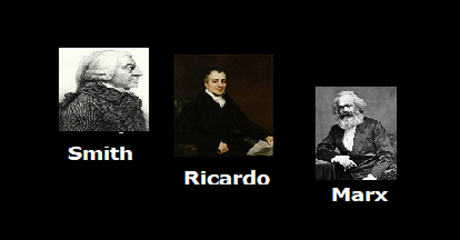
In reviewing Marx's The Poverty of Philosophy, I will show that Smith, Ricardo,
and Marx knew the limitations of their theory and could have gone beyond it
using the small yet growing category of products.
First, to reiterate Marx's final formulation of his theory of value from the
first volume of Capital:
"The labor...that forms the substance of value is homogeneous human labor,
expenditure of one uniform labor-power. The total labor power of society, which
is embodied in the sum total of the values of all commodities produced by that
society, counts here as one homogeneous mass of human labor-power, composed
though it be of innumerable individual units. Each of these units is the same as
any other, so far as it has the character of the average labor-power of
society, and takes effect as such; that is, so far as it requires for producing
a commodity, no more time than is needed on an average, no more than is socially
necessary. The labor-time socially necessary is that required to produce an
article under the normal conditions of production, and with the average
degree of skill and intensity prevalent at the time"...."Simple labor, it is
true, varies in character in different countries...but in a particular country
it is given. Skilled labor counts only as simple labor intensified." (my
emphasis)
It is evident that for Marx, the value of commodities is determined by the average
labor-power of society. In fact, all producers need to produce within the range
of the average and no drastic difference between the least efficient and the
most efficient can impose a continuous presence in the conditions of general
commodity production (what he called capitalist production but is in fact true
for industrial production whether capitalist or socialist, and maybe the
averaging mechanism is even stronger under socialism.) In other words, if a type
of production is too inefficient, it will be dropped out and if it is highly
efficient, then other competitors necessarily catch up quickly (the more
advanced the industrialization, the quicker the process of averaging). Thus, for
industrial production, it is not only averaging in theory, but the whole general
process of production itself that inclines towards the average in the real life.
Industrial production as a whole, with its standardization of production and
labor, makes every process of production gravitate towards the average. The more
advanced the industrialization, the faster the gravitation. In fact the
consequences of a developing industrial society made averaging a reality in most
realms of life as well as in the theoretical schemes of the last part of the
nineteenth century. It came to be believed that everything will become a
commodity, even most human beings themselves.
The averaging phenomena was, on the positive side, responsible for the rise of
much of modern social science, such as economics and sociology; on the negative
side, it was a methodological shortcoming which lost sight of realms of life
that were not determined in this manner and in which uniqueness counted more
than averages.
Did the classical economists know that labor-time value was not the only unit of
economic reality when they proposed this averaging theory? I think they did and
I would like to explore this different category of value, what I will call
"uniqueness value" in the remainder of this paper.
PART II-Historical Notes On
*Uniqueness Value*
All three major classical economists, Smith, Ricardo and Marx, were aware of the
limitation of their theoretical model. Marx quotes Ricardo in the Poverty of
Philosophy as follows:
"Possessing utility commodities derive their exchangeable value from two
sources: from their scarcity, and from the quantity of labor required to obtain
them. There are some commodities, the value of which is determined by their
scarcity alone (my emphasis). No labor can increase the quantity of such
goods, and therefore their value cannot be lowered by an increased supply. Some
rare statues and pictures, scarce books...are all of this description, their
value...varies with the varying wealth and inclination of those who are desirous
to possess them." (As I will show later, Marx did not believe that their "value"
varies, rather he said their "price" was a monopoly price.)
Ricardo did not notice that what was true about rare works of sculpture was also
true for the musical works of his day and even the copyright of his own book.
The question that needed answering was: How do these products become valuable or
valueless without average out?
For if Ricardo had noticed a wider range of products in this category and if he
had noted the growth of this type of products alongside the reduction of the
work-week, he would have grasped their significance for the future economic
reality. He preceded Marx in stating that:
"these commodities, however, form a very small part of the mass of commodities daily exchanged in the market."
Although
Ricardo's statement was true about the economic reality of his time, but the
situation was progressively changing.
Neither Smith, Ricardo nor Marx could have accounted for the price of their own
work, that is the copyright of their books, on the basis of their own criteria
of value. Because philosophers of Greece and the early modern scientists were
not a large enough social group, their "products" did not enter the market as a
significant portion of the total social product. But in the post-industrial
society the volume of tool-like human activity (work) drops and the free
creative activity of human beings keeps increasing. (Even though the increase is
not in proportion to the drop in work-time.*) The growth of this kind of human
activity in our times is the significant reason for our ease at recognizing this
category of products. Electronic media, for example, has contributed to this
growth by allowing a piece of music to be recognized as a masterpiece (or a
worthless patchwork) in a fraction of the time it took some of the great
composers such as Bach to be recognized. The processes of elimination and
rehabilitation have both been speeded up enormously and proportionate to each
other.
Historically, Ricardo specifies the commodities he has in mind when proposing
the theory of value:
"In speaking then of commodities, of their exchangeable value, and of the laws
which regulate their relative prices, we mean always such commodities only as
can be increased in quantity by the exertion of human industry, and on the
production of which competition operates without restraint." (Ibid)
Thus, one restraint is the impossibility of producing another Mona Lisa (i.e.
uniqueness) and the other one is monopolization of the market. The first
restraint was almost forgotten whereas the second one was recognized by some
Marxist economists like Hilferding.
Marx continues with Ricardo's quotation of Adam Smith from the Wealth of
Nations:
"That this (i.e. labor time) is really the foundation of the exchangeable value
of all things, excepting those which cannot be increased by human industry, is a
doctrine of the utmost importance in political economy; for from no source do so
many errors, and so much difference of opinion in that science proceed, as from
the vague ideas which are attached to the word value."
Marx quotes Ricardo approvingly that there is no necessary connection between
price and value of those "rare" commodities. They both did not believe that the
value of such commodities could be determined in a different way and still be
exchangeable with other commodities. These rare commodities exemplify what I am
calling uniqueness value produced from the free creative activity as
differentiated from the labor-time value produced from the tool-like activity.
As I will show later from Capital Volume III, when Marx reviews the
determination of general price of production, he only uses the monopoly price
explanation when addressing these product.
Marx quotes Ricardo as saying:
"Commodities which are monopolized, either by an individual or by a company,
vary according to the law which Lord Lauderdale has laid down: they fall in
proportion as the sellers augment their quantity, and rise in proportion to the
eagerness of the buyers to purchase them; their price has no necessary
connection with their natural value: but the prices of commodities, which are
subject to competition, and whose quantity may be increased in any moderate
degree, will ultimately depend, not on the state of demand and supply, but on
the increased or diminished cost of their production."
Both Marx and Ricardo are, in fact, confusing the determination of these two
kinds of values with the correlation (transmutation) between the two. I will
demonstrate later that the price of those commodities varies in relation to the
uniqueness value just like the price of other commodities varies around the
labor-time value. What should be accounted for by the eagerness of the
purchasers, etc. is not the relation of price to value but is the relation of
labor-time value to the uniqueness value. The two are incomparable, like apples
and oranges, but because of this, eagerness can determine the relationship. It
is like trading peace for war indemnities.
Marx had always agreed with Smith and Ricardo in regard to the independence of
the price of such commodities to their value. He called this price the monopoly
price. Not only in the Poverty of Philosophy of 1857 but even in the posthumous
publication of Capital (Vol. 3) he repeats the same view:
"When we refer to a monopoly price, we mean in general a price determined only
by the purchasers' eagerness to buy and ability to pay, independent of the price
determined by the general price of production, as well as by the value of the
products. A vineyard producing wine of very extraordinary quality which can be
produced only in relatively small quantities yields a monopoly price. The wine
grower would realize a considerable surplus profit from this monopoly
price, whose excess over the value of the product would be wholly determined by
the means and fondness of the discriminating wine-drinker..." (my emphasis)
He goes on to express the same view with regard to differential rent. Marx,
therefore invents the concept of surplus profit to avoid accepting
*monopoly* price as the expression of some kind of value (what I think is
uniqueness value).
I believe that the reason for Smith, Ricardo and Marx's reluctance to accept two
different measures of value is the difficulty of explaining the exchange between
the two. They thought that if the two can be exchanged, then it is not actually
two measures but it is one measure in two forms. And if they are really two
measures of different kinds, then exchange would be impossible, apples and
oranges! In other words, if the value of two kinds of commodities is determined
in two substantially different measures, how could they have something in common
to make them comparable (exchangeable).
When the measure of value for standard products is labor-time and the measure of
value for unique commodities is creativity, the question may seem like asking
how labor-time can be traded with creativity. Labor-time is the average labor
power of society, a physical quantity, whereas creativity is like a
psychological/aesthetic quality.
What Marx reminds us of in the first volume of Capital, when differentiating use
value and exchange value, is that we need to have something in common to compare
or exchange. Of course he is right about the differentiation of use value and
exchange value not because of incomparability but because just usefulness
nothing would gain an exchange value. Let me continue the discussion of our
topic about two kinds of exchange values. Marx even quotes Aristotle's
declaration that we need to have something common to compare or exchange. Thus,
he could not accept two kinds of measures of exchange value without
contradicting himself. (It was logically an Aristotelian mistake for a
Hegelian!) But the reality is that such exchange happens as the exchange of
"incomparable" items.
When a piece of music is accepted as valuable (based on a reason different from
labor-time), the decision to find an equivalent from labor-time values (or their
money equivalent) is made on a unique basis based on eagerness and ability to
pay. As stated before, it is just like trading peace for war indemnities. One is
a political entity whereas the other is an economic calculation. The everyday
exchange within each of the two realms is completely different and has its own
"laws", but the exchange between the two is made on a unique basis (not on the
"average"). It is also like the difference between Newton's acceptance of only
one force, gravity, in contrast to Einstein's acknowledgement of the four forces
and the endeavor to unify them without a mental pre-reduction of all of them to
one. What the grand unification theory might be like is left open at this point
but I believe the acknowledgment of the two kinds of value is inescapable.
In summary, Marx and Ricardo's mistake was that they thought the "monopoly
price" was set according to the willingness of the parties involved. They did
not see the possibility that there could be two kinds of value which could be
transmuted by the final arbiter of economic relations, i.e., the social decision
or what they called people's willingness, whether due to economic,
psychological, aesthetic reasons or just due to craziness as may be observed in
the coming and going of fads both in the capitalist and the socialist countries.
The mechanism of the transition from one kind of value to the other may prove to
be as difficult as the unification of the four forces in modern quantum physics.
PART III-The Foundations of the Two Kinds of Value
There are two kinds of human activities (see Sam Ghandchi "Intelligent Tools:
The Cornerstone of a New Civilization"): The first kind is tool-like activity
which is standard and the other is free creative activity which is unique. "(Hu)man
was used as a tool whenever his sense perceptions and locomotive abilities,
language understanding, and special skills were utilized as means of production
(i.e. means to an end). To the degree (hu)man is clipped of his versatility and
his freedom is limited in order to conform to the production process, the more
tool-like he becomes. In contrast, (hu)man remains an end in himself and is not
reduced to a special tool to the degree versatility, knowledge, and
sophistication prevail in his productive activities."
On the one hand, with advances in automation, creative products can be mass
produced very quickly. On the other hand, standardized production requires less
human work. In fact, what differentiates "work" from other forms of human
activity is not its being physical (versus mental) or unskilled (versus
skilled). Whether the human activity is an expenditure of perception,
locomotion, or language and special skills as means of production or not, work
must be defined on a different basis.
What Marx calls labor power is an inadequate term because it does not show the
significance of perception and language skills - Taylor's transformations can be
used for quantifying such abilities (See Braverman, Harry - Labor & Monopoly
Capital, 1976). Labor time, however, is meaningful for work. But if the same
activity, for example, physical activity for pleasure rather than work, is done
by an individual as a free human activity, it is no longer work and cannot be
evaluated by labor-time even if its product enters the market in a future date
(like some works of art or music). Mostly work is paid in a short time by the
general equivalent (money), whereas free human activity (most creative
activities) may never be compensated in money. Thus, what differentiates mental
and physical or skilled and unskilled labor does not differentiate work and free
human activity.
The difference between these two kinds of human activity was exemplified in
slave societies where, in practice, two kinds of human beings existed. Slaves
were doing tool-like activities and the free citizens were mostly doing free
human activities. A peasant spent more time as a tool-like instrument than a
feudal baron. In the later stages of human society, most cultures threw out the
idea of two kinds of people and instead accepted an idea of one species,
inherently "equal". The differentiation between the two kinds of activity thus
became implicit within the life of every individual.
In the industrial society, the differentiation within every individual reached
its peak. Activity as a tool versus activity as a free individual, hours of work
versus hours of leisure, etc. were clearly marked. The mistake of most
economists and Marxists in particular was in their lack of comprehension of this
fact and thinking in terms of mental versus manual or skilled versus unskilled
labor when they were facing discrepancies in their economic calculations
especially after the sudden fall of the work week in the industrial societies.
For example, lifting weights for muscle building is "fun" and is not work
although it is extremely physical whereas programming computers for the one
writing subroutines for a corporation's accounting system, although very mental,
is nonetheless work, exactly in the sense of a tool-like activity. The less
human beings spend their time in tool-like activities as a consequence of the
fall of the work week, the more "the essential human activity will resemble the
free exploration of an affluent artist than the soldier-type obedience of a
fortuneless laborer" (Ibid). I will come back to the subject of the affluent
artist, but for now I will explore the dilemma of how these two kinds of human
activity, work and free creative activity, can be accounted for in economic
terms.
I think as far as tool-like human activity is concerned, the industrialized
model of work is the most advanced form of averaging and takes us the farthest
in actually eliminating work. ("Work" in the sense discussed above. Although one
can use this term for other types of human activity if one recognizes the
connotation of the usage, e.g., if one likes to call children's homework work
knowing the difference between his meaning and the historical meaning of the
term referring to tool-like activities. Philosophers or scientists as early as
ancient Greece would not call their activities "work!") Moreover, the best
economic description of work in its most advanced form in the industrial society
has been given by the theory of labor-time value. I think the human activity as
such can be best measured as Marx formulated, by the minimum necessary to keep
this "tool" alive to perform. Even more educated "tools" in such tool-like
activities are paid as a more expensive "tool" whose cost of education is
treated as a refinement. I think the Marxian model is complete for that kind of
human activity and once the other kind of human activity is separated from it,
most discrepancies will disappear.
Labor-time value is determined by averaging, i.e., every form of labor-time
participates in this kind of general price of production. The value
determination of products of creative activities is done in a different way *not
by averaging* but by recognizing the *best*. If there is a marathon, the
average runner is of no significance in determining the rewards. Runners are
awarded in comparison to the best runners in other countries, past years, other
regions or schools, etc. The average of different years or different regions or
different groups is of no significance for the value determination. The scores
are compared between the best and not between the averages. But the award of the
best is determined by the willingness of the awarding committee, city council,
Olympic board, etc. (Here is the transformation from one kind of value system to
another.) Or, what makes a work of art valuable is not its position relative to
the average works around (in time and space) but its place relative to the best
works determine its value. The criteria may be aesthetic, historic, faddish,
etc. It is not important what makes a product of creative activity the best or
whether it really is the best or is believed to be the best. What is important
is the fact that all other works are not measured relative to the average and
are evaluated relative to the best. In short, uniqueness value is measured from
the best product of the similar activity.
Now, a product of a creative activity may be the best and very valuable, but
nobody may be willing to trade it with money (labor-time equivalent). In such
cases the transformation from one kind of value to the other does not occur. For
example, the best work of Middle Eastern philosophy may not find a publisher to
pay even a couple hundred dollars for its publication even if all the experts in
the field consider it the most valuable. Such are the problems of the
transformation between the two kinds of value systems. The determination of the
uniqueness value and its transformation can be a broad area of inquiry
especially as the trends in the post-industrial societies are conducive to its
growth. (Once the best is recognized and exchanged with money, millions of
copies are made in the other sector of the economy, the standardized industrial
sector, in which everything is done by labor-time value system.)
PART IV-The Dilemma of Social Justice Revisited
There seems to be a basic injustice in the distribution of income that, I
believe, comes from the ranks of the practitioners of the free creative activity
themselves.
I claim that since free creative activity is becoming the major portion of human
activity in post-industrial societies, the question of a fair or just
distribution of wealth has shifted from the relationship of owners to non-owners
to the relationship of the best creator/performer to the average (or below)
creators/performers. In other words, injustice is evident when a top musician or
movie star makes millions whereas an average musician cannot even receive a
minimum wage for his/her profession. They are not members of opposite classes
and with both capitalist and socialist measures, the top performers cannot be
accused of "exploiting" others. Yet, it is within the ranks of the producers
that one must look for answers to the question of distribution of income in
post-industrial societies.
The fact is that in contemporary society, the free creative activity of
individuals replaces tool-like work as the major portion of human activity. The
social groups that are primarily involved in such activities are the major
social forces of the future society. Thus, questions of social justice must
increasingly take these groups into account.
In ancient Greece it was not of primary importance if the distribution of income
among philosophers was just or unjust: They were essentially acting as a part of
other social groups (e.g. their source of income was the same as slave owners in
Greece and likewise it was the same as the feudal lords in medieval Europe). But
although in the industrial sector of developed countries the question of justice
is still related to the labor-time compensation in relation to ownership,
management, and meritocratic privileges, etc., it is not true for the people who
are involved in non-tool-like activities. (The concept of labor-time here is
meaningless whether you are the "owner", "manager" or "laborer" of these
activities.)
For example, a musician who sells millions of copies of his tape gets the bulk
of the profit even though the company that buys the copyright makes
"surplus-value" from the production process. The other musicians who are
suffering and feel "exploited" would not feel any better if the capitalist gave
them all the proceeds of their not-selling piece of music. Neither is the other
capitalist who is promoting the music of their colleague "exploiting" them.
(Even though their celebrity colleague may sometimes complain about his
contractors, he hardly feels exploited either.) In reality it is their colleague
who is reaping the fruits of the activity of their whole social group because
his work is the best (or accepted as the best).
The same is true in movie production, book writing, software design,
architectural plans, etc. For simplification purposes, let's look at a
capitalist/worker model. If we had a factory with 1000 workers and only the best
worker was paid the wages of 800 workers and the rest were unpaid, would the
question of justice be related to the capitalist who does not pay the surplus
value (say equivalent to the wages of 500 workers) or the "superworker" who is
"legitimately" taking the wages of 800 (and is still himself giving out
"surplus-value" to the owner!)
The carpenter of classical economists would make a table cheaper or more
expensive relative to the average cost of production. But Leonardo's Mona Lisa
is worth much, much more than its paper and ink and its "labor-time" cost even
if Leonardo was hired by the most generous employer. On the other hand,
thousands of works of art are worth less than the paper and ink used to produce
them and are dumped as trash. (Any publisher could give you the figure for the
dumped hardcovers). It is looking for the best that justifies the fact that of
one hundred text books on the Strength of Materials, ninety-nine have to fail!
Even if all revenues from the sale of the product are given to the composer of a
failed music piece, the musician would still not even meet the minimum survival
needs. If the publisher of a not-so-terrific book does not even take any
"surplus value" and gives all the proceeds to the writer, the writer will still
suffer injustice but not from the owner (manufacturer, or publisher, etc.). If
his book is really worthless, and not judged so simply because of social trends,
then even public opinion is not responsible for the injustice.
On the other hand, if a best-seller book pays lots of "surplus value" to the
publisher, the "superprofit" of the author is still not comparable to that of
the printer. The author will sell the copyright for subsequent paperbacks, mass
paperbacks, books-on-tape, movies, plays, etc., if his book keeps on selling for
decades. In such cases the injustice is not due to the employer, it is not even
in the industrial work-place anymore. Instead, it is within the creative groups
themselves. When a top violinist is making money like a millionaire and an
average violinist cannot even make a minimum wage in his profession, then the
dilemma of justice is not between the owner of the means of production and the
worker, but is implicit in the ethical principles governing the reward of
creative activities in our society.
It is true that the same problems of just compensation could have been mentioned
for creative professions in the Middle Ages. The crucial differences are: the
speed in which works can be eliminated and "the best" determined (the Oscars,
the Grammy's, the Pulitzers, etc.), and the continuous rise in the significance
of the creative activities in contemporary life.
Compensation and rewards for sports or scientific theories is similar to what
was done in ancient Greece but it is done quicker and on a more global scale.
Yet musicians may still have a fate like Mozart if they are not recognized as
the best in their lifetime. The problem is not that of payment for the
"necessary" labor-time versus nonpayment of the "surplus" value. The problem is
that of social responsibility which is not contained in the reward system.
I think the people who are involved in creative activities are the principle
builders of the future human civilization. The issue of justice is a central
problem to our future quality of society. Yet because it is a problem between
professional colleagues rather than between two opposite social classes,
recognition of the issue is difficult. Star performers continue to appropriate
the legitimate expectations of the average and lower ranked performers. Even
rewarding on the basis of needs (welfare state) does not solve this problem
because it does not recognize intention as a basis for reward (such as the
intention of an anonymous composer is not legitimate for need-based reward
system which prohibits him from even composing.) The "needs" of a well-known
musician for an expensive secluded place for mediation is the same as that of an
anonymous (or even bad) musician. The "needs" independent of intentions are
meaningless for these groups (just having food and shelter is not enough to
compete with Picasso, especially if you live in Bangladesh).
The difference between an advanced shoe factory and an average or a less
developed one is not much and the better than average makes a super-profit which
is soon averaged out in the industry. But the difference between a music tape
that sells one hundred copies and a hit that sells millions, has nothing to do
with averaging, etc. There is no law that obliges such hit creators to subsidize
or help the well being of others in the same profession. He is taxed for his
income as if he had made it in manufacturing or real estate. The allocations of
money to music foundations is not directly related to the income of the stars
because it is a free country.
In the ethics and law of the industrial society, it is assumed, rightfully, to
expect factory owners to be taxed for the welfare and social security of their
workers and such measures are no longer viewed as the "infringement" of freedom.
But in the case of the artist/workers, to be taxed in favor of the low paying
members of their own profession is frowned upon. I think even professional
organizations (in which celebrities usually do not participate) are an
expression of the needs of the lower ranks of such professions to claim their
share of the income. Maybe unconsciously the term social-responsibility used by
some of these organizations like Physicians for Social Responsibility or
Computer Scientists for Social Responsibility, is more an expression of a
yearning for justice for themselves!
PART V-Conclusion
The value of the commodities is determined by the law of labor-time value
(averaging) in the industries and the law of uniqueness value when human
activity is not tool-like. Nonetheless, as Marx said, the question of justice is
not in recognizing the mechanism of value determination and whether the full
value is realized; the question is in introducing a different social
distribution system (and ethics). Contrary to Marx, I think that the
distribution system is not a direct continuation of the production system. The
law of labor-time value is true for the industrial production (determination by
the average) whether the distribution is capitalistic or socialistic. I think
the same is true for the law of uniqueness value (determination by the best).
Once recognizing its mechanism, we need to propose an alternative distribution
system and I consider what I proposed in the last section as an attempt in this
direction. The problem of social justice has shifted from opposing social
classes to within social groups or classes.
I believe that just as in physics there are four forces (or five as some
physicists believe); in economics we have two values. And as in physics, where
the unification has already been achieved between the two forces of
electromagnetic and the weak force, I think my proposal for the unification is
one possible way of study in economics. But my main purpose in this article was
to show the significance of the law of uniqueness value and the need for dealing
with the unification problem of this scheme and to see its implication for
addressing the dilemma of social justice in the near future.
Hoping for a democratic and secular futurist republic in Iran,
Sam Ghandchi
IRANSCOPE
http://www.ghandchi.com/index2.html
November 24, 2003
* The above paper was originally written in 1989 and was first posted on SCI (soc.culture.iranian) Usenet newsgroup on March 28, 1994. This Nov 24, 2003 edition includes a new preface. A Persian version is also added in this 2003 edition.
Related Works
Intelligent Tools: The Cornerstone of a New Civilization
http://www.ghandchi.com/353-IntelligentToolsEng.htm
ابزار هوشمند: شالوده تمدنی نوین
http://www.ghandchi.com/353-IntelligentTools.htm
Social Justice and the Computer Revolution
http://www.ghandchi.com/238-SocialJustice.htm
عدالت اجتماعی و انقلاب کامپیوتری
http://www.ghandchi.com/265-EconJustice.htm
Alternative Income-Social Justice in
Post-Industrial Society
http://www.ghandchi.com/427-AlternativeIncomeEng.htm
درآمد آلترناتیو-عدالت اجتماعی در جامعه فراصنعتی
http://www.ghandchi.com/427-AlternativeIncome.htm
Marxist Thought & Monism -Second Edition
http://www.ghandchi.com/2055-MarxismEng.htm
اندیشه مارکسیستی و مونیسم -یکتا گرائی
http://www.ghandchi.com/2055-Marxism.htm
Mr. Piketty, Winner-Take-All is the Problem
http://www.ghandchi.com/835-piketty-winnertakeall-english.htm
آقای پیکتی، اینکه برنده همه چیز را تصاحب می کند مسأله است
http://www.ghandchi.com/835-piketty-winnertakeall.htm
**********************************************
Feb 3,2003
From: gerald_a_levy (gerald_a_levy@msn.com)
Date: Mon Feb 03 2003 - 09:42:34 EST
Yet another way of conceptualizing this topic has
been offered by Sam Ghandchi in an article entitled
         "A Theory of Uniqueness Value."
http://www.ghandchi.com/28-Higher_Product_Value.htm

In this paper, which presents a "knowledge theory of value",
Ghandchi argues that there are two types of commodities --
those whose values are determined by the law of value
and commodities whose values are determined by the "law of
uniqueness value."   A self-described "Futurist",   Ghandchi
wrote elsewhere that he agreed with 99% of the writings of
Daniel Bell.

Solidarity, Jerry
This archive was generated by hypermail 2.1.5 : Tue Feb 04 2003 - 00:00:01 EST
**********************************************
Featured Topics
http://featured.ghandchi.com

For a Secular Democratic & Futurist Republican Party in Iran
http://www.ghandchi.com/futuristparty/index.html